 Rehman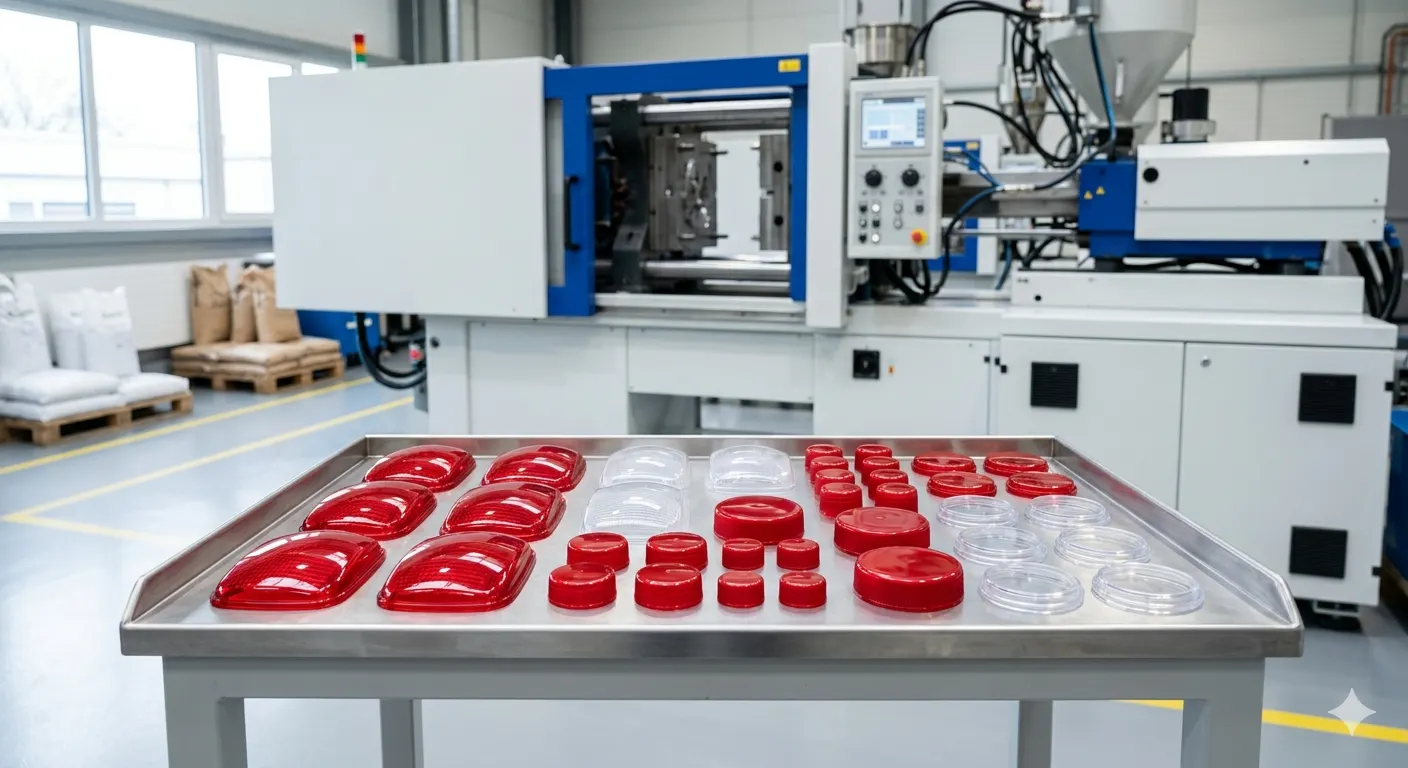
The short answer
Injection moulding produces the rigid parts of plastic packaging: caps, closures, containers and tubs, buckets and pails, lids, crates, trays, and the preforms that later become PET bottles. It does not produce bottles, films, bags or shrink sleeves — those come from blow moulding and extrusion.
In Pakistan, packaging is one of the highest-volume applications of injection moulding, and volume is exactly what makes the economics work. A cap that costs PKR 3 to mould at 5,000 pieces costs closer to PKR 1.60 at 500,000 — and packaging buyers are usually ordering in the hundreds of thousands.
This article covers what can and can't be moulded, what it costs, what changes when the part touches food, and how to plan a packaging launch so you don't pay for the wrong tooling.
What injection moulding makes in packaging — and what it doesn't
Getting this right at the start saves you from quoting the wrong process. Injection moulding is the right process for:
Caps and closures. Flip-tops, screw caps, dispensing caps, child-resistant closures, spouts. Almost always multi-cavity — an 8, 16 or 32-cavity tool is normal because volumes are huge and the parts are small.
Containers, tubs and pots. Ghee and margarine tubs, ice cream containers, yoghurt pots, paint and chemical containers, cosmetic jars. Thin-wall moulding territory — fast cycles, high injection pressure.
Buckets and pails. Paint buckets, food-grade pails, agricultural buckets, along with their lids and handles.
Crates and trays. Fruit and vegetable crates, bottle crates, bakery trays, poultry and hatchery trays, industrial stacking bins. Large parts, big presses, long cycle times, but very durable and reusable.
PET preforms. The small test-tube-shaped piece that becomes a PET bottle is injection moulded, then stretch-blow moulded into the final bottle. Two different processes, two different suppliers, often confused by first-time buyers.
Injection moulding is the wrong process for: bottles and jerry cans (extrusion blow moulding), plastic bags, films and wrappers (film extrusion), pipes and straws (profile extrusion), and thin disposable clamshells and trays made from sheet (thermoforming). If a supplier quotes you injection moulding for a bottle, they are either misunderstanding the part or subcontracting it.
What packaging parts actually cost in Pakistan
Packaging economics are dominated by two things: cavity count and cycle time. Because the parts are small and the volumes are enormous, the tooling conversation is very different from a one-off custom part.
Tooling. A single-cavity cap mould is almost never worth building. Realistic tooling for packaging-scale work in Pakistan: a 4–8 cavity closure mould lands around PKR 400,000–900,000; a 16-cavity closure tool runs into the low millions; a single-cavity crate mould (large part, big tool) is typically PKR 1,200,000 and up. Container and tub tooling sits between the two depending on size and cavitation.
Per-part cost. Rough Pakistani ranges at production volume: PKR 1.5–6 for caps and closures, PKR 8–35 for tubs and containers depending on wall thickness and size, PKR 60–180 for buckets and pails with lids, and PKR 250–900 for crates, which are heavy and use a lot of resin.
The volume rule that decides everything. Multi-cavity tooling costs roughly 2.5–3× a single-cavity tool but produces 4× the parts per cycle. If your annual volume is above roughly 100,000 pieces, multi-cavity is not a luxury — it is the only way your per-part cost will be competitive. Below about 20,000 pieces a year, you are usually better off buying a stock off-the-shelf container than commissioning custom tooling at all.
That last point is the honest one most moulders won't lead with. If you need 5,000 branded jars, buying a standard jar and printing a label on it will beat custom tooling every time. Custom packaging tooling makes sense when the shape itself is part of the product, or when your volume is high enough to amortise it.
Food-contact packaging — what actually changes
If your packaging touches food, medicine or cosmetics, four things change and each of them costs money. Any moulder who tells you nothing changes is not doing food work.
Virgin resin only, no regrind. Normal moulding recycles sprues and rejects back into the batch. Food-contact work uses virgin food-grade PP or HDPE with no reground material, because you cannot certify what was in the regrind. Expect a material cost premium of roughly 8–15%.
Food-grade colour masterbatch. The pigment has to be food-approved too. Cheap industrial masterbatch in a yoghurt pot is a real failure mode, not a theoretical one.
Barrel purge and line segregation. The machine has to be purged before a food run, and ideally the tool is not run immediately after a filled-nylon or heavily pigmented job. This is machine time you are paying for.
Documentation. For domestic sale you will want the resin maker's food-grade certificate and, depending on the product, PSQCA marking. For export, buyers routinely ask for FDA or EU 10/2011 compliance statements on the resin and the masterbatch. The moulder cannot invent these — they come from the raw material supplier and get passed through to you.
Ask for those certificates before the tooling is cut, not after the first production run. Discovering that your resin has no food-grade documentation when a buyer audits you is an expensive way to learn this.
The details that separate packaging moulders from general moulders
Packaging buyers care about things a general custom-parts buyer never asks about. If you are sourcing packaging, these are the questions worth asking:
Lot-to-lot colour consistency. Your tub has to be the same shade in January and in July, across different resin batches. Ask how colour is matched and whether they keep a retained sample for reference.
Dimensional consistency on sealing surfaces. A cap that seals on one lot and leaks on the next is a recall. The sealing diameter and thread profile are the critical dimensions — ask whether they are checked every run or only at first-article.
Weight control. Packaging is sold by the piece but costed by the gram. A container that drifts from 18 g to 20 g quietly destroys your margin across 200,000 pieces. Serious packaging moulders monitor shot weight.
Stacking and nesting behaviour. Crates that don't stack squarely and tubs that jam when nested cause warehouse and filling-line problems that never show up on a sample of five pieces.
In-mould labelling (IML), if you need it. IML places the label in the cavity before injection so it becomes part of the wall — premium finish, no separate labelling step, but it requires robotics and specific tooling. It is available in Pakistan but not from every moulder, and it changes the tooling spec, so raise it at quoting stage or not at all.
Planning a packaging launch without wasting money
The most common expensive mistake is committing to production tooling before the pack design is settled. A sensible sequence:
Step 1 — fix the volume and the fill. Know your realistic monthly volume and exactly what goes inside. Wall thickness, material and closure type all follow from the contents.
Step 2 — check whether a stock item already fits. If a standard container and a printed label solve the problem, take that route and spend the tooling money on marketing instead.
Step 3 — if you need custom, prototype first. 3D print the pack, fill it, cap it, drop it, stack it, put it on a shelf. Design faults are free to fix at this stage and expensive to fix in steel.
Step 4 — consider a soft or low-cavity tool for the launch. A 2-cavity tool for the first 20,000–50,000 pieces validates the market. If the product sells, cut the 8 or 16-cavity production tool with everything you learned. If it doesn't sell, you lost a fraction of the money.
Step 5 — only then commit to production tooling. By this point you know the shape works, the fill works, and the volume is real.
Lead times to plan around in Pakistan: roughly 3–6 weeks to build a straightforward closure or container tool, 6–10 weeks for a large crate tool or a high-cavitation closure tool, then 1–2 weeks for trials and first-article approval before regular production starts.
Local versus imported packaging
Imported packaging from China is genuinely cheap per piece at very high volume, and for some commodity items it is hard to beat. But packaging is bulky, and that changes the maths in ways the unit price hides.
Freight is charged by volume, not weight. Empty containers and crates are mostly air. A container-load of empty tubs costs the same to ship as a container-load of something dense and valuable, which is why imported packaging economics collapse below very large order sizes.
Minimum order quantities are brutal. Importing usually means committing to a full container of one SKU in one colour — often 6–12 months of stock, paid upfront, sitting in your warehouse.
Reorder speed. Running out of caps with a local moulder means a 1–2 week reorder. Running out with an imported supply chain means 8–14 weeks including shipping and clearance, and a production line standing idle.
Tooling control. A locally-held mould can be inspected, modified and repaired. A mould sitting in a factory overseas effectively belongs to that factory in every practical sense.
The pattern that works for most Pakistani packaging buyers: source locally for anything you reorder frequently or might need to change, and import only stable, very high-volume commodity items where you can absorb the stock.
Bottom line
Injection-moulded packaging is a volume game. Get the process right (moulding for rigid parts, blow moulding for bottles), get the cavitation right for your real volume, and be honest with yourself about whether the pack needs to be custom at all.
If it touches food, sort out virgin resin, food-grade masterbatch and certificates before the tooling is cut. If it's a launch, prototype and use a low-cavity tool before committing to production steel. And if you reorder often, keep the tooling and the supplier close to home.
Rehman Industry moulds packaging components in Gujranwala — crates, containers, bins, buckets, closures and custom parts — with tooling built and maintained in-house. Send us the part, the material and your monthly volume, and we'll come back within a business day with tooling cost, per-piece cost at three or four volume tiers, and a realistic lead time.
What we do at Rehman Industry
Need a quote for your part?
Send us your drawing, sample or just a description. We'll reply within a business day with real numbers.

